Skeletal
Structure:
Sonic
Level:
HYPOTHESIS
Introduction:
Although Sonic is bipedal, it is impossible for him to have the same
bone structure has humans. There are forces that Sonic regularly experiences
that the human skeletal and muscular structures have not evolved enough
to handle. In fact, the bipedal skeleton goes further from allowing
faster speeds to be reached at all. The human being is one of the slowest
of all mammals. Even a chicken can run faster than us.
This is because when we evolved to stand on two legs we gave up many
parts of bone structure that attribute to speed, strength and other
qualities that animals have over us. In order for Sonic to overcome
the difficulties that humans have, we have to assume that he evolved
past the normal bipedal bone structure and into something that does
not exist on Earth.
Spinal
Structure:
The
human spine has evolved from the arched spine of the animal into taking
on the shape of an S-curve. Why do I mention this? It is important to
realize the function of the spine and how it performs it. The spine
of quadraped (an animal that walks on all four legs) is in an arch in
order to evenly display the weight over what acts as a shock absorber.
The spine is able to bend downwards in the middle and absorb the shock
that jumping, running and other actions might cause the body to take.
When humans evolved to walk on two legs, then weight was then directed
in a different direction and the arched spine would not suffice. And
so humans evolved their spine into what might not be the best shape
but what was a far better shape than the arched spine, which was an
s curve. This provided some shock absorbtion which, along with the feet,
made upright walking possible. The S curve bends alone the center of
the S and downward along a line pointed straight down through it. This
alleviates some of the pressure.
When dealing with Sonic, we have another problem that must be dealt
with. We have to cover force and pressure from two different directions.
First, since Sonic is bipedal, he will have the same issues that a human
has. (By the way, this is just due to the weight of the human or anthro
pulling straight down due to gravity). However, a problem that Sonic
runs into that humans do not, quite literally, is that he runs so quickly
that the amount of force that wind pressure places on the front of his
chest is another force that has to be dealt with. Therefore, Sonic's
spinal structure would have to evolve further than the human's.
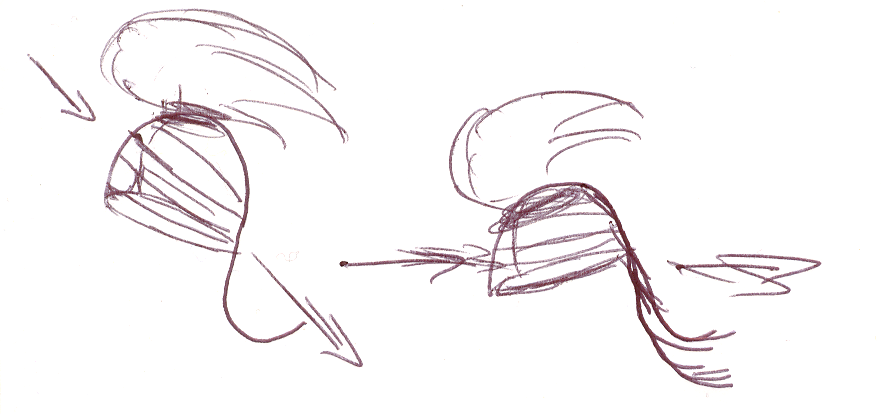 Looking at the picture on the left (this is a diagram I drew of Sonic;'s
spinal and rib structures in standing and walking positions along with
the directional vectors of the ribcage and to some degree the spinal
structure' most comfortable direction in which it can displace force).
As you can see, or maybe not because I am not the best artist, is that
the the spine would be facing in a more north-west direction. This is
because Sonic bends down slightly when he runs in order to achieve some
degree of streamlining. You'll notice that unlike the human ribcage,
Sonic's ribcage has the ribbones at an angle just like the S-curve of
his spine. Also, the tail becomes an important part of the spine, completing
the S-curve. Also, the spine splits into a V around the ribcage and
falling into almost straps on Sonic's chest. This would provide added
support in protecting Sonic's ribcage. (Do not, however, thing that
the ribcage is only for protection. Mostly is is actually to keep structure
while the lungs expand and contract.) *What I did fail to draw in these
drawings are how the shoulders work into the equation. However, at t
his point, I do not believe there is a reason to think that Sonic's
arms are significantly different from human arms.*
Looking at the picture on the left (this is a diagram I drew of Sonic;'s
spinal and rib structures in standing and walking positions along with
the directional vectors of the ribcage and to some degree the spinal
structure' most comfortable direction in which it can displace force).
As you can see, or maybe not because I am not the best artist, is that
the the spine would be facing in a more north-west direction. This is
because Sonic bends down slightly when he runs in order to achieve some
degree of streamlining. You'll notice that unlike the human ribcage,
Sonic's ribcage has the ribbones at an angle just like the S-curve of
his spine. Also, the tail becomes an important part of the spine, completing
the S-curve. Also, the spine splits into a V around the ribcage and
falling into almost straps on Sonic's chest. This would provide added
support in protecting Sonic's ribcage. (Do not, however, thing that
the ribcage is only for protection. Mostly is is actually to keep structure
while the lungs expand and contract.) *What I did fail to draw in these
drawings are how the shoulders work into the equation. However, at t
his point, I do not believe there is a reason to think that Sonic's
arms are significantly different from human arms.*
Foot Structure:
If you read the paragraph above about Sonic's spine, then you might
remember that I said that feet are part of the human's structures to
absorb shock. The way the human foot works is that the foot bone is
a double arch, which is able to stretch downwards under the weight of
the human body. This, when combined with the many tendons and ligaments
that keep the bones in place and attached to the muscles, is extremely
important to our ease in being bipedal. This can easily seen by examining
those who are afflicted with flat feet. People with flat feet not only
their feet hurting after a decent walk but also their spine. This is
because the foot has no arches (or shock absorbers) and more of the
job of absorbing that shock going straight into the spine. However,
as I said in the absove paragraph, the S-curve of the spine isn't the
best way to distribute weight and that is the reason of the
back pain.
Sonic has a problem, and it doesn't have to do with standing. It comes
with the fact that he has to be pounding his feet onto the earth while
running at the extreme speeds that he does in order to propel his body
forwards. If you want to see this, try jumping up and down on the ground
barefoot. You SHOULD feel it more than if you do it with sneakers on.
This is because the sneakers provide added absorbtion. Sonic, however,
moves at such a high speed that even his specially designed sneakers
don't seem like they might be enough to handle it. Also, since the bone
structure isn't the only thing that causes Sonic to be so fast, one
must assume that the bones would have to evolve with the muscles and
brain in order for him to even be feasible of reaching any high speed.
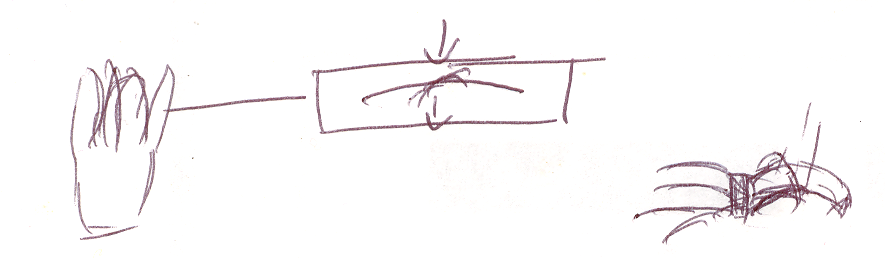 In the picture to the right, I painfully badly draw my concept for Sonic's
foot's bone structure. First of all, since when you run you are brought
up to your toes (try to run very fast and keep aware with what is hitting
the ground first), we have to assume that Sonic's toes, unlike human
toes, also have to be very proficciant in absorbing shock. And because
of this we might assume that: (1) Sonic's toes are significantly larger
than the human toe and that (2) each of Sonic's toes has a similar arch
structure as the human foot. This would be far more shock absorbtion
towards the act of running than the human has, allowing Sonic to slam
his feet against the ground with greater force than any mere human.
Add this with his special shoes and it might be enough.
In the picture to the right, I painfully badly draw my concept for Sonic's
foot's bone structure. First of all, since when you run you are brought
up to your toes (try to run very fast and keep aware with what is hitting
the ground first), we have to assume that Sonic's toes, unlike human
toes, also have to be very proficciant in absorbing shock. And because
of this we might assume that: (1) Sonic's toes are significantly larger
than the human toe and that (2) each of Sonic's toes has a similar arch
structure as the human foot. This would be far more shock absorbtion
towards the act of running than the human has, allowing Sonic to slam
his feet against the ground with greater force than any mere human.
Add this with his special shoes and it might be enough.
However, the arch of Sonic's foot (which is there because of his bipedal
nature) is the worst shape to distribute any force left over from the
toes. It is for this reason that I believe that there is another bone
in the foot, one that Sonic has developed and that humans never did.
It is this bone's job to create a semi-portable arch in the foot when
Sonic is running and to slide into disuse when he is standing.
The nature of this foot and spianl structure would make Sonic actually
more comfortable and design to run than to stand, which would offer
an added physical nature to his inability to stand still for any given
length of time. Not only would it hurt him mentally, but it actually
might begin to cause him some minimal physical pain (like what the flatfoot
feels while walking).
Coming Soon: Leg Structure, Knee Structure.
Conclusion:
Sonic was built to run. His skeleton has evolved in such a way to make
him a creature that is not only built for speed but made him more comfortable
while he is running. Obviously, muscle strengths and development of
certain tendons have to be concided when looking at his amazing running
ability, but eventually they will be discussed. For now, let us just
contemplate and appreciate what an amazing anatomy a hyperfast biped
must have.