Name:
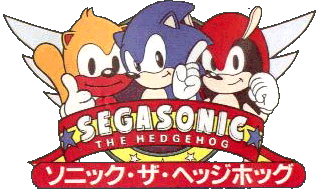
SegaSonic The Hedgehog
Other Names (Nicknames): SegaSonic,
SegaSonic Arcade, Sonic Arcade
Release Dates:
June, 1993 - Japan
September, 1993 - USA
September, 1993 - Europe
Quality: 32-bit Arcade
coin-op
Game System(s): Arcade
(Sega System 32)
Also released on: N/A
Developer(s): Sega of
Japan
Character Introductions: Mighty
the Armadillo and Ray the Flying Squirrel.
Region Game Takes Place On: Eggman
Island.
Concept Introductions: SegaSonic
Arcade actually introduced the isometric gameplay before Sonic
3D Blast. The objective was just different. It was the traditional Sonic
style of gameplay — get to the end of the zone. However, the difference
is, there is ALWAYS something chasing you down such as a giant gear,
a bunch of icicles, a crumbling floor, or a giant Eggman machine. These
dangers along with the occasional hazard in your path, are the only
things that can harm you in this game — no badniks. This is obvious
since it's an arcade game. You can't sit still forever in any arcade
game. There are seven known zones, and each of them have the same aforementioned
gameplay style. All three characters have the exact same gameplay; no
special moves for each of them. And the only thing they can do besides
run is the tried-and-true spinball jump. Moving the character was done
by a trackball, which works a lot like a trackball mouse, which automatically
confirms that playing this game was a bitch. Apparently, 3 people could
play at a time as Sonic, Mighty, and Ray.
Concept Deductions: No Special Stages, no powerups,
no score, no Chaos Emeralds, no checkpoint markers, no badniks, no nothing.
The ring-survival system is not in SegaSonic Arcade since if you're
good enough, you can permanently stay in game if they kept it. Instead,
you get a health bar, and rings just replenish a bit of the health.
Once you lose all your health, you lose a credit. Other than that, nothing
else is changed.
Storyline:
Sonic and his
new friends Mighty the Armadillo and Ray the Flying Squirrel have been
captured by a giant machine that is shaped like Eggman's face, and now
they must escape from his base on Eggman Island, and at the same time,
perhaps destroy it all.
Personal Criticism/Opinion:
SegaSonic
The Hedgehog didn't exactly get the largest of releases here
in the United States, like most Sonic arcade games. It's even rarer
than Sonic The Fighters. Ironic, since its popularity at the 1993 Consumer
Electronics Show in Vegas was astounding. Its distribution among Western
markets, regardless, was nothing short of scarce. Damn those Japanese
for not giving us this game. (*Shakes fist.*)
The gameplay is
pretty much the same as any normal Sonic game. Just get to the end of
the zones. But as mentioned, it is in an isometric view, and the control
of the characters is done through pushing the palm of your hand along
a trackball while tapping away at a single button to make the character
jump. The game's distribution on the internet was never even that good
either since the only available SegaSonic Arcade ROM is a prototype
dump where only five of the zones are playable before you get a Game
Over message. A small cutscene displaying Robotnik pressing a button
behind an immense control panel (probably to activate some trap; this
IS his turf afterall) links each zone, which has a name scheme that
was the first to coin the "same starting letter" gig seen
in Sonic CD, and Sonic 3D: Flickies' Island: Volcanic Vault Zone, Trap
Tower Zone, Landslide Limbo Zone, Icy Isle Zone, Desert Dodge Zone,
Wild Waterway Zone, and the pattern breaker, Eggman's Tower.
Next up, character
intros. Ray The Flying Squirrel was a one-off hit, basically. Showed
up once, nothing is known about him, and he's never coming back, especially
since he was not even distributed well across American and European
audiences. All that is known is that he's yellow and he's a flying squirrel.
A rumor has been made that his tail is real strong, and that he can
stand on it (which wouldn't be surprising), but it has never been confirmed.
And then there
is Mighty the Armadillo. SegaSonic the Hedgehog was the game Mighty
made his debut on. NOT Knuckles' Chaotix. So this proves that Mighty
isn't just some Sonic copy. (However, it is possible that Mighty was
made even before Sonic since the two remaining animals that were to
be chosen to be SEGA's mascot were a hedgehog, and an armadillo…
hmmm.) In this game, like Ray, Mighty was given very little depth and
charisma. He was just there for the gameplay. It wasn't until Chaotix
that Mighty was given an age of 16 and a peacuful and resourceful personality.
Let's see some GAMER'S PERSPECTIVE:
Replay value? Eh, well, for the ROM, the replay value is pretty
much the same as any Sonic game. But if you happen to run into an arcade
platform for this thing outside the internet, I imagine the replay value
isn't good unless you're willing to spend a quarter to play again, even
if you've beaten it.
Graphics? The graphics in SegaSonic Arcade are great. A whole
lot better than its opposing Sonic 3D: Flickies' Island (the Genesis/Mega
Drive version anyway). The objects for the levels and the template pieces
are very well rendered with some of the utmost detail (especially all
of the ash and burnt metal from after you destroy the machine on Landslide
Limbo Zone). The character sprites were also well done. Maybe a bit
more shading and they would have been perfect.
Music & Sound Effects? Eh, from the ROM, the music isn't
good enough to even criticize. Its real glitchy and fuzzy. But it was
afterall a prototype ROM, so I'm in no position to judge. If you manage
to pick up the ROM, don't look forward to any good tunage.
Storyline? First time Sonic's ever actually been captured
and forced to journey through a region completely under Eggman's control.
S'not bad.
OVERALL RATING? I rate SegaSonic The Hedgehog as a 7/10.